Pupupul: what we checked
Discussions of promotion in ChatGPT, Claude or Perplexity often begin with special files and keyword lists. We decided to start with a more practical question: what does a search engine actually receive when opening the website, and can it understand the product unambiguously?
We chose Pupupul for the review — a service from Uzbekistan for tracking personal money and business finances. The website presents multiple currencies, financial reports, calculators and a public demo. It is a useful example: there is both a product that could be recommended and content that could serve as an answer source.
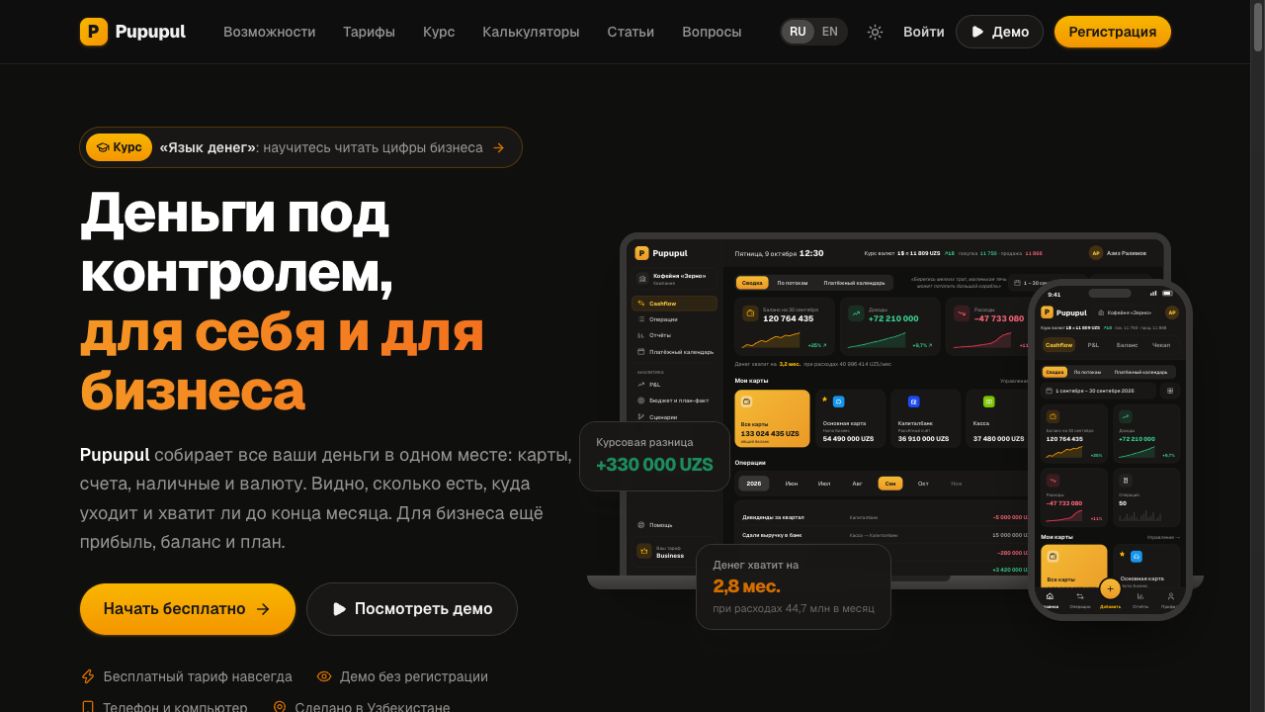
First, we checked whether the website is accessible
We opened robots.txt, the sitemap and all 19 addresses listed in it. We checked server responses, each page’s primary address — the canonical — indexing restrictions and text in the initial HTML.
Check results: 19 of 19 sitemap pages returned HTTP 200; 6 articles with lastmod; 8 calculator pages.
Across this sample, canonicals point to their own pages, and no noindex restrictions were found in HTML or response headers. The homepage and reviewed articles contain readable text directly in the server response: JavaScript execution is not needed to retrieve the main content.
Robots.txt permits crawling of public pages. The homepage also returned HTTP 200 in three requests with OAI-SearchBot, Claude-SearchBot and PerplexityBot User-Agent strings. This tests the server’s reaction to those headers, not actual visits by those companies’ crawlers.
The technical foundation conclusion: we found no blanket crawl or indexing block in the tested sample. These results do not require rebuilding the website merely so that “AI can see the HTML.”
For AI Overviews and AI Mode, Google retains ordinary search requirements: a page must be indexed and eligible to show a snippet. Special markup “to get into AI” is not required. Source: Google Search Central .
First fix: one consistent pricing description
The most noticeable issue was in the homepage content. The free business plan Mini includes P&L and Balance Sheet. However, the FAQ lists these features as reasons to upgrade to a paid plan, and the “What’s inside” section marks P&L and Balance Sheet with a Business label. All three formulations are accessible in the initial HTML of the same page.
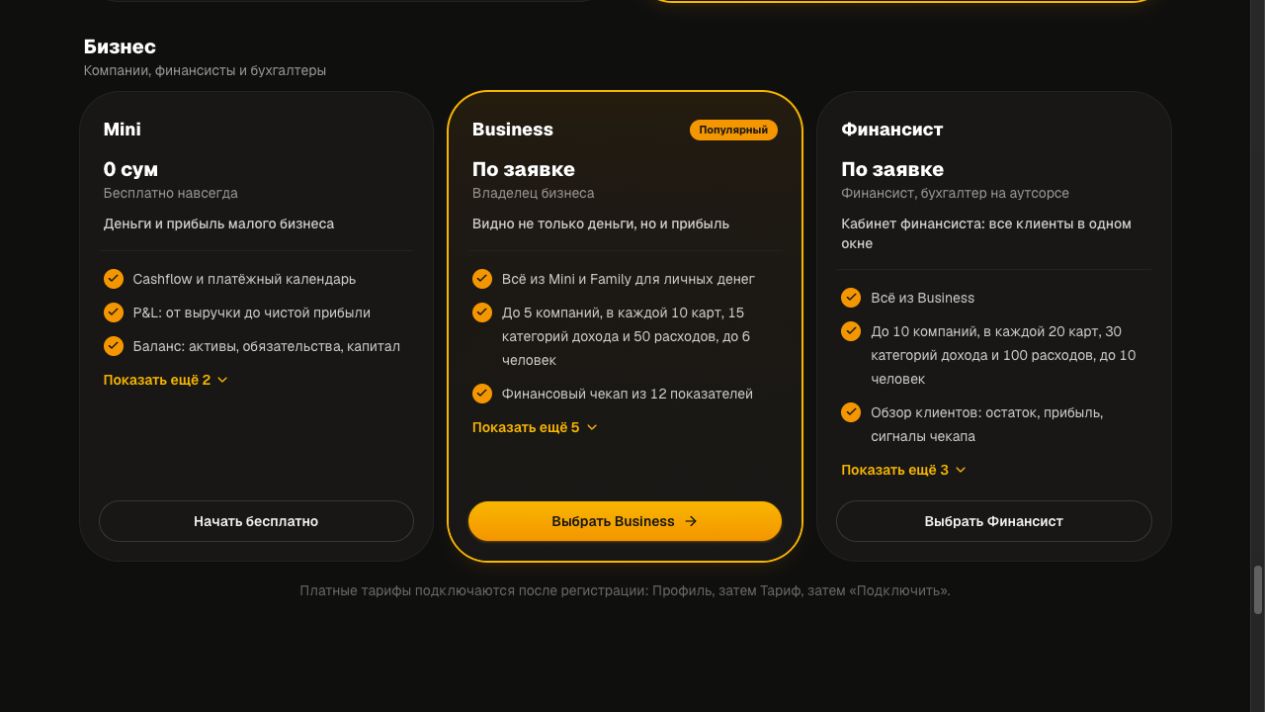
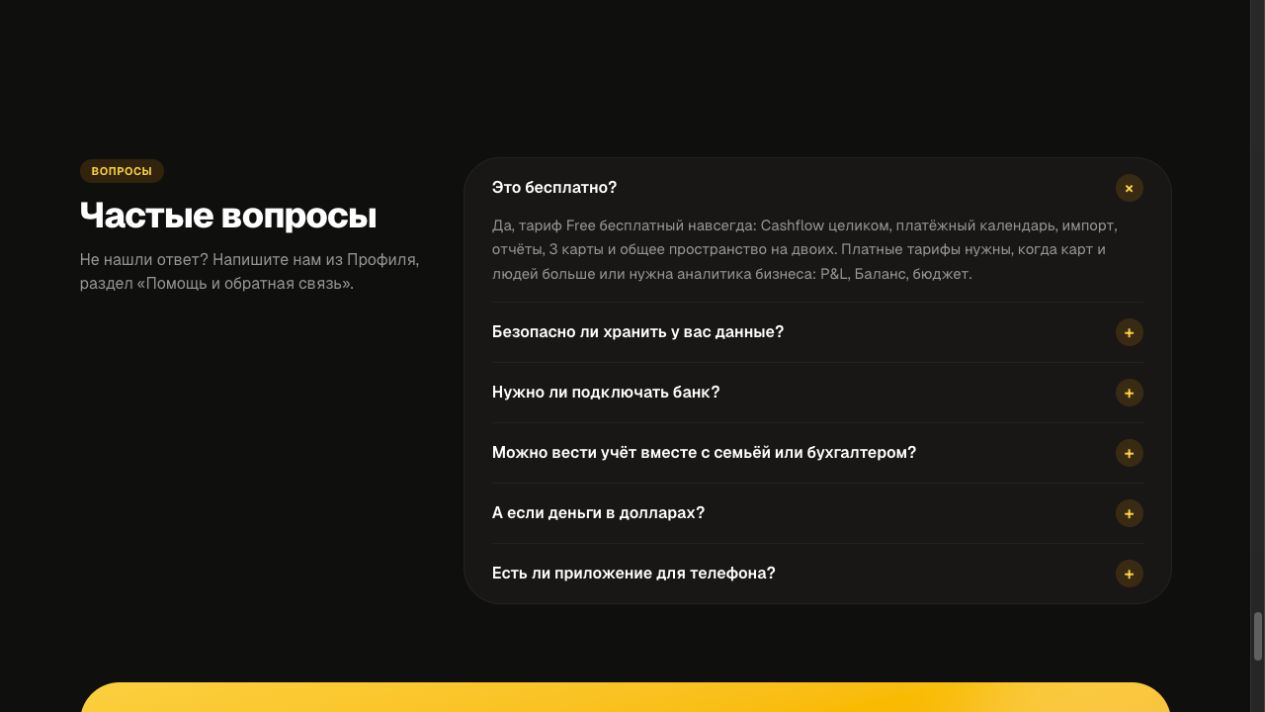
For a person, this is a reason to clarify the terms. For a system composing an answer from page fragments, it creates ambiguity: one fragment supports calling a feature free, another paid. This is our assessment of information quality; we did not measure the effect of this specific inconsistency on model answers.
What to do: confirm the current plan matrix and synchronize pricing cards, the FAQ, feature descriptions and future markup with it. If access depends on limits or the contents of a report, explain the difference directly. Accurate terms matter more here than additional brand-name repetition.
Second fix: separate addresses for languages
The website has a Russian/English switch. During the homepage check, English text was returned at the same URL depending on the Accept-Language header or a language cookie. We found no separate language-version links or hreflang on the reviewed pages. The English HTML still used lang="ru".
Google recommends separate URLs for language versions rather than relying on cookies and browser settings; otherwise, a search engine may not discover every version. Source: Google documentation on multilingual websites .
What to do: create stable addresses, such as /ru/ and /en/ , connect translations using ordinary links and hreflang, and set appropriate canonicals and document languages. This is a proposed structure, not existing Pupupul addresses. For an English-speaking audience, this improvement appears a priority.
The incorrect lang should be fixed for markup correctness and accessibility. However, Google identifies language from visible text, so it would be incorrect to call this attribute alone the reason for missing indexing.
Third improvement: describe the product and authorship more clearly
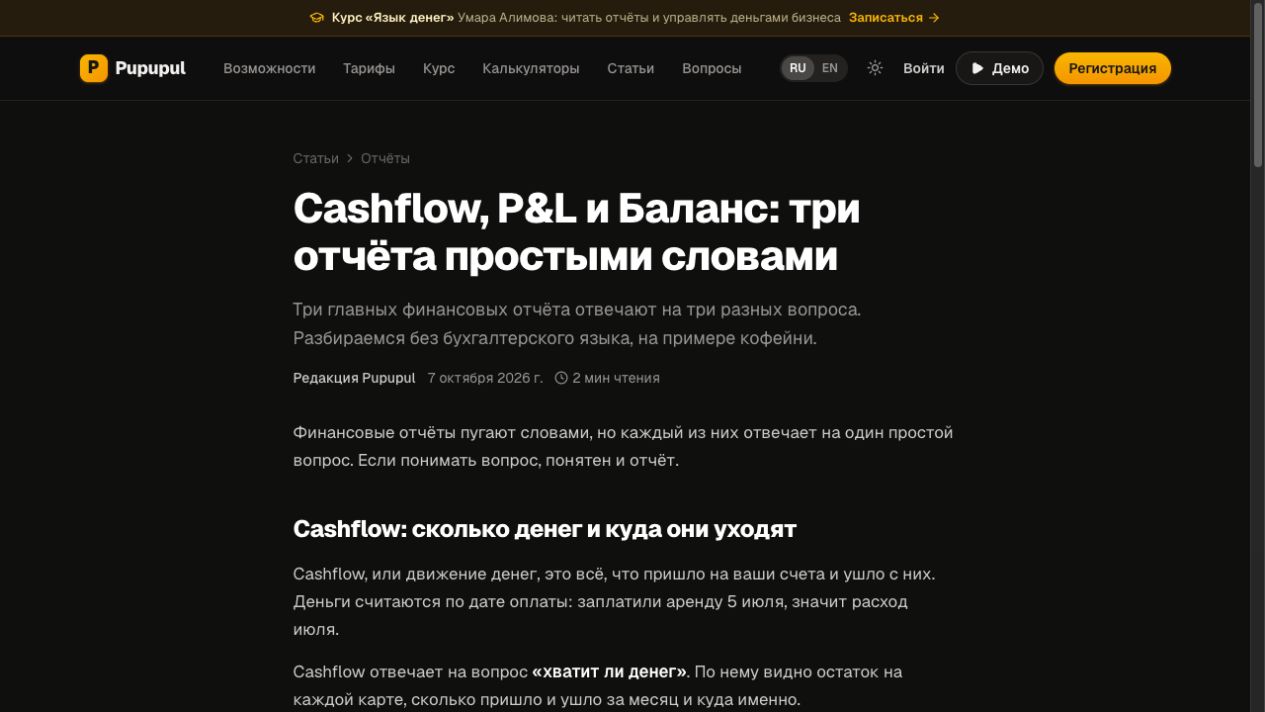
Pupupul already has useful content. For example, the article about Cashflow, P&L and Balance Sheet divides the topic into clear questions and connects its explanation to the product demo. The six reviewed articles display a date and editorial byline.
We found no JSON-LD or microdata on the 19 checked pages. A structured description of the product, organization and articles could be a next step: SoftwareApplication, Organization, Article and BreadcrumbList where they match the content. Markup dates and authors should agree with visible information.
For financial content, I would also add a clear page about authors and editorial review, links to primary sources for verifiable external facts, and an explanation of calculator assumptions. Name a specialist only if they genuinely participated in preparation or review.
The absence of schema alone does not exclude the website from search or prove a lack of citations. The priorities here are consistent facts and useful content; markup describes them.
Which questions to test next
To evaluate recommendations, use potential customer questions rather than only queries containing Pupupul’s name. For the next stage, we would choose these scenarios:
• Which service is suitable for tracking small-business finances in Uzbekistan? • Where can I track personal expenses in soms and dollars? • Is there a free service with P&L and Balance Sheet for small businesses? • Which tool should I choose for a family budget in several currencies?
These are proposed test scenarios, not an export of real user queries or an estimate of their volumes. For each, save the date, chosen AI service, answer and links: whether Pupupul is mentioned, what is said about pricing and whether a citation leads to the intended page.
The order in which I would continue
1 — Plan terms across every section — No contradictions in HTML about P&L and Balance Sheet availability
2 — Addresses and links for language versions — Each translation opens at its own URL without depending on cookies
3 — Product and author descriptions and markup — Facts, dates and authorship match the visible page
4 — Discovery and result checks — Search engine data, AI answers with links and observed visits
After publishing fixes, inspect important addresses in Google Search Console and Bing Webmaster, then repeat the chosen AI questions and compare the answers. Referral analysis requires the website’s own analytics: some sources can be identified through referrers and tags, while some visits remain unattributed.
This review shows why we are building AURA GEO : to connect website checks, specific tasks, agent work and confirmed results. First put the information in order, then check what changed in search, answers and visits.
About the review
This review was conducted on 18 October 2026 using public pages, HTTP responses, robots.txt, the sitemap and initial HTML. The recommendations in this article have not yet been applied to the Pupupul website. Its traffic, actual search index positions and citations in model answers were not measured in this review.
The audit record and primary sources are listed below. A page being accessible to a request and being selected as an answer source are different stages.
Sources
- https://www.pupupul.uz/
- https://www.pupupul.uz/#pricing
- https://www.pupupul.uz/#faq
- https://www.pupupul.uz/robots.txt
- https://www.pupupul.uz/sitemap.xml
- https://www.pupupul.uz/articles/cashflow-pnl-balans-prostymi-slovami
- https://developers.google.com/search/docs/appearance/ai-features
- https://developers.google.com/search/docs/specialty/international/managing-multi-regional-sites
- https://developers.openai.com/api/docs/bots
- https://aurageo.io/assets/articles/pupupul-geo-review/audit.json