Appto: a software website that needs a clear explanation for search
Appto is a Mac application that takes your iPhone app from idea to the App Store. It finds a niche using live App Store data, designs the app, writes native SwiftUI code, creates screenshots and ASO in every language, and submits it to Apple from your account. It works with the Claude Code or Codex subscription you already have: your code and keys stay on your Mac.
On 20 October 2026, AURA GEO checked 10 public HTML pages on appto.store: the homepage, feature directory, ASO, niche discovery, blog, comparisons, FAQ, a page for reviewers, one study and one comparison. We also retrieved robots.txt, the sitemap index and seven nested sitemaps. This is a technical and editorial website review. We did not install the application, purchase a subscription or test publishing an app to Apple.
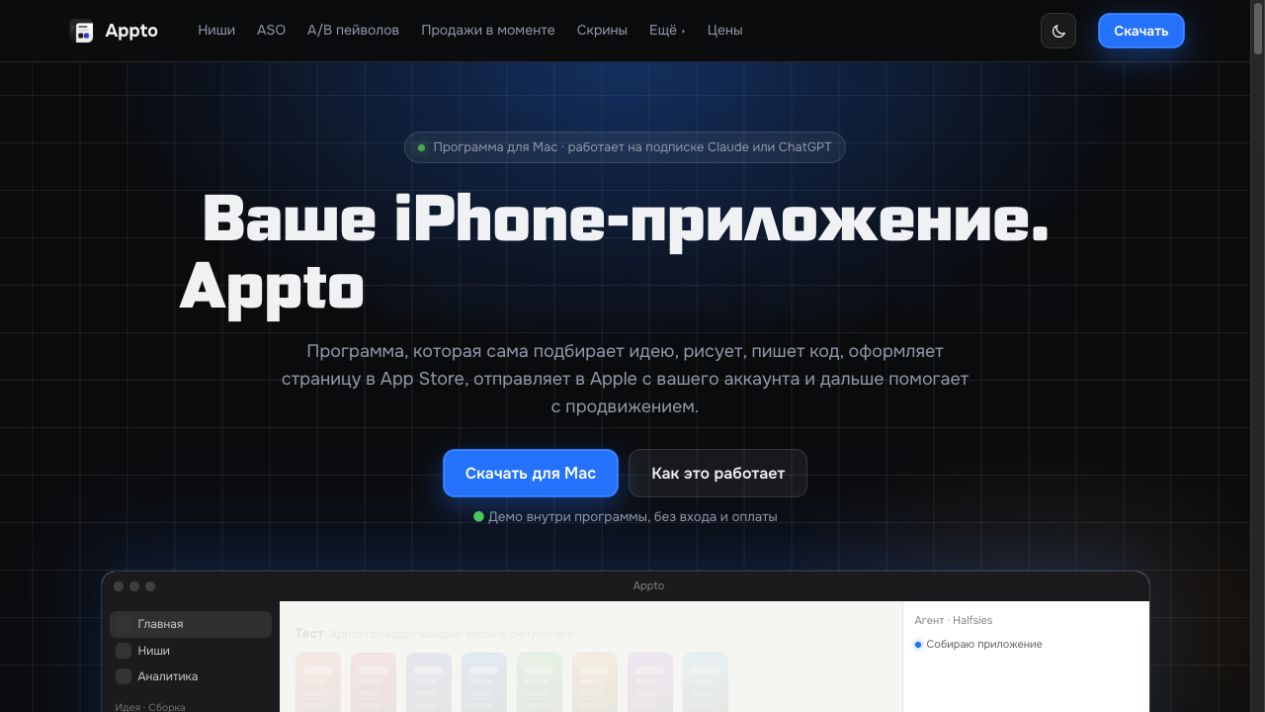
The SEO technical foundation already exists
All 10 reviewed HTML pages returned HTTP 200. Each had one H1 and a self-referencing canonical. The sample contained no meta robots or X-Robots-Tag HTTP header blocking indexing. Text is available in the initial HTML: a crawler receives the product description and articles without mandatory JavaScript execution.
Robots.txt permits public sections and blocks internal routes, including API, account and payment routes. This is a sensible distinction: search needs product explanations, not personal workspaces. A general Allow: / is sufficient for public paths when no more specific restriction applies. Adding every AI service’s name to robots.txt does not itself create citations.
The sample includes JSON-LD, including Organization, SoftwareApplication, Article/BlogPosting and breadcrumbs. All detected blocks parsed as JSON. We checked syntax, not Google rich result eligibility or every property’s compliance with all Schema.org requirements.
324 sitemap URLs organize the library; they do not prove indexing
The main sitemap was an index of seven sitemaps: pages, blog, comparisons, ideas, ASO, categories and glossary. Together they contain 324 unique URLs; all 10 selected pages are included. This is a good entry point for crawling, but the number cannot be called a count of pages in Google, Bing or AI answers.
The reviewed pages specify en, ru and x-default language alternatives. This approach helps connect versions of the same content. The owner’s next check is hreflang reciprocity between languages and excluded-URL reports in their own search engine accounts. Our Russian-language sample did not include a full audit of every English counterpart or all 324 addresses.
ASO and GEO solve different tasks
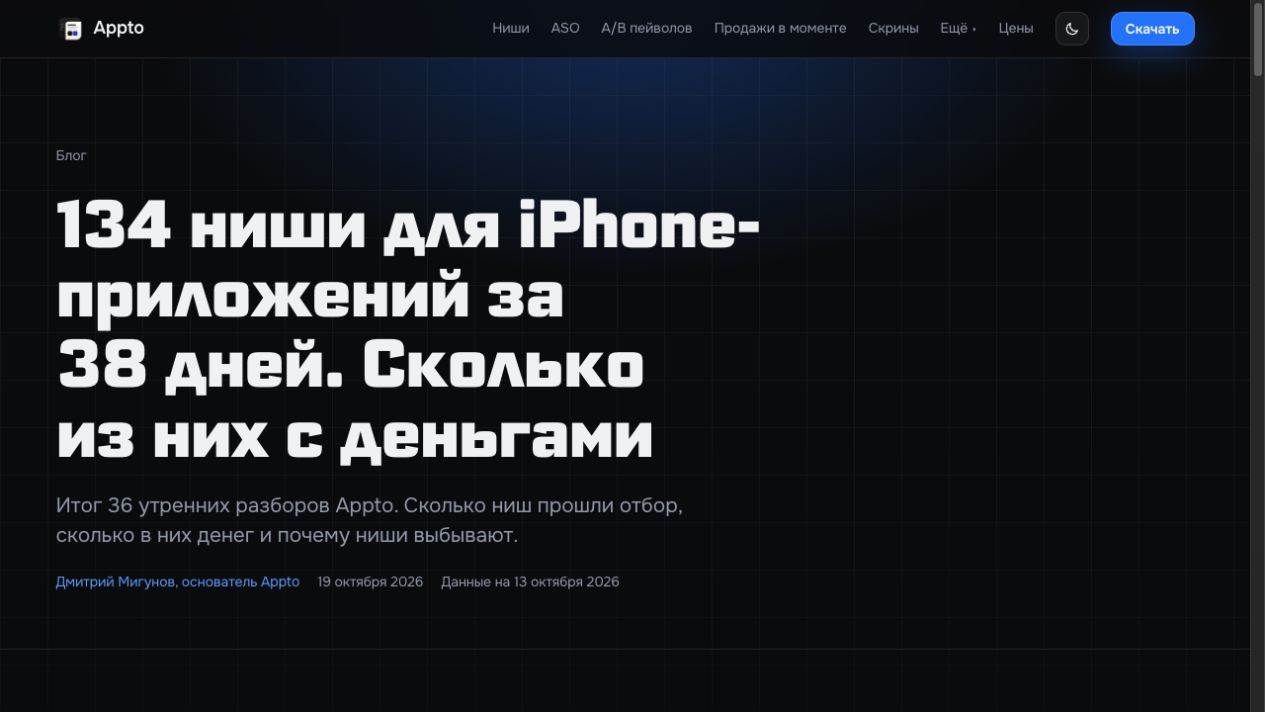
Appto has a dedicated ASO page explaining work on an app’s name, subtitle, keywords and description in the App Store. That concerns app discovery in Apple’s store. Our review concerns another surface: the public appto.store website, which can become a source for web search and an AI answer.
The page’s strength is its distinction between application actions and user decisions. It explains which texts are prepared automatically and what a person needs to choose. For a question such as “what helps prepare an iOS app listing,” this specificity is more useful than a general promise that “AI does everything.” We did not measure the effectiveness of the ASO features or app rankings.
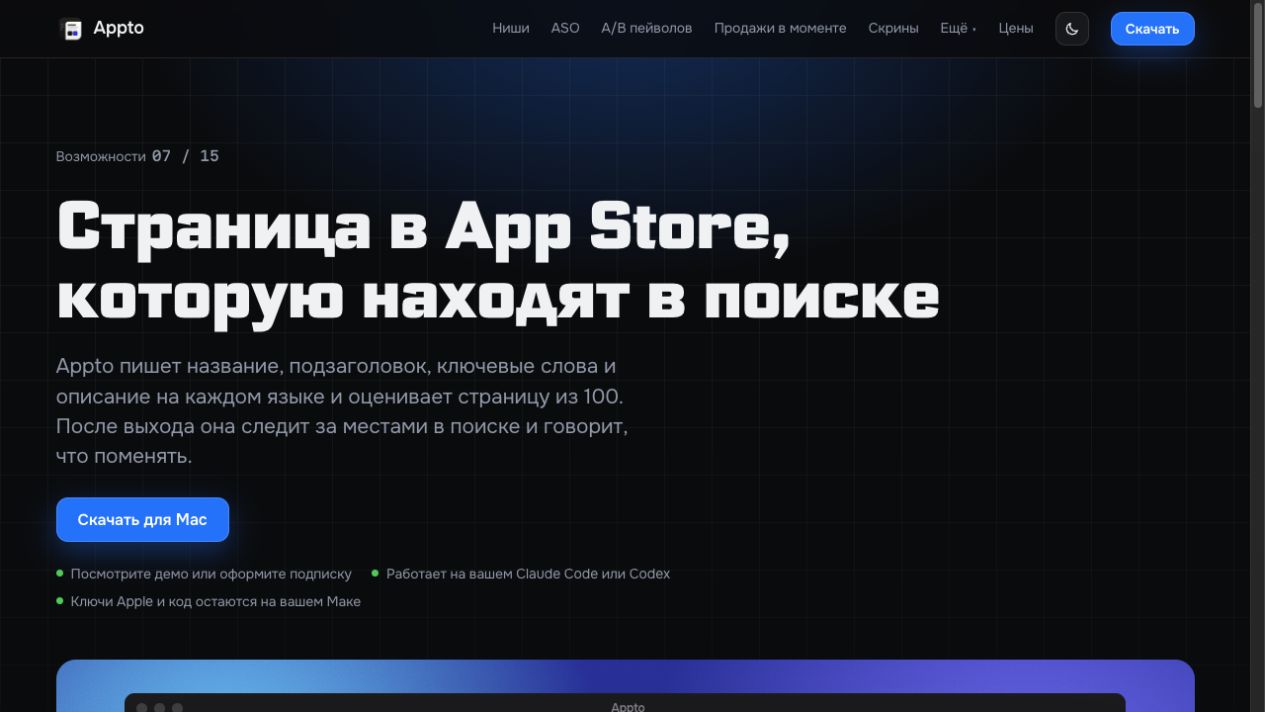
Public pricing provides material for comparison
The homepage already publishes prices, application limits and tier contents. At the time of the check, the ruble version showed Solo at ₽790 per month; Studio for up to 10 apps at ₽790 for the first month and ₽1,790 thereafter; and Pro for up to 100 apps at ₽7,990 per month. It separately explains the need for your own agent subscription and an Apple developer account for publication. This is information from the website on the check date, not our payment verification.
For GEO, this transparency is useful: a comparison of tools can link to a specific page with terms rather than repeat an unverifiable promise. A future improvement is to maintain consistent current terms across the homepage, comparisons, FAQ and structured data. A promotional price should always be accompanied by the price for subsequent months.
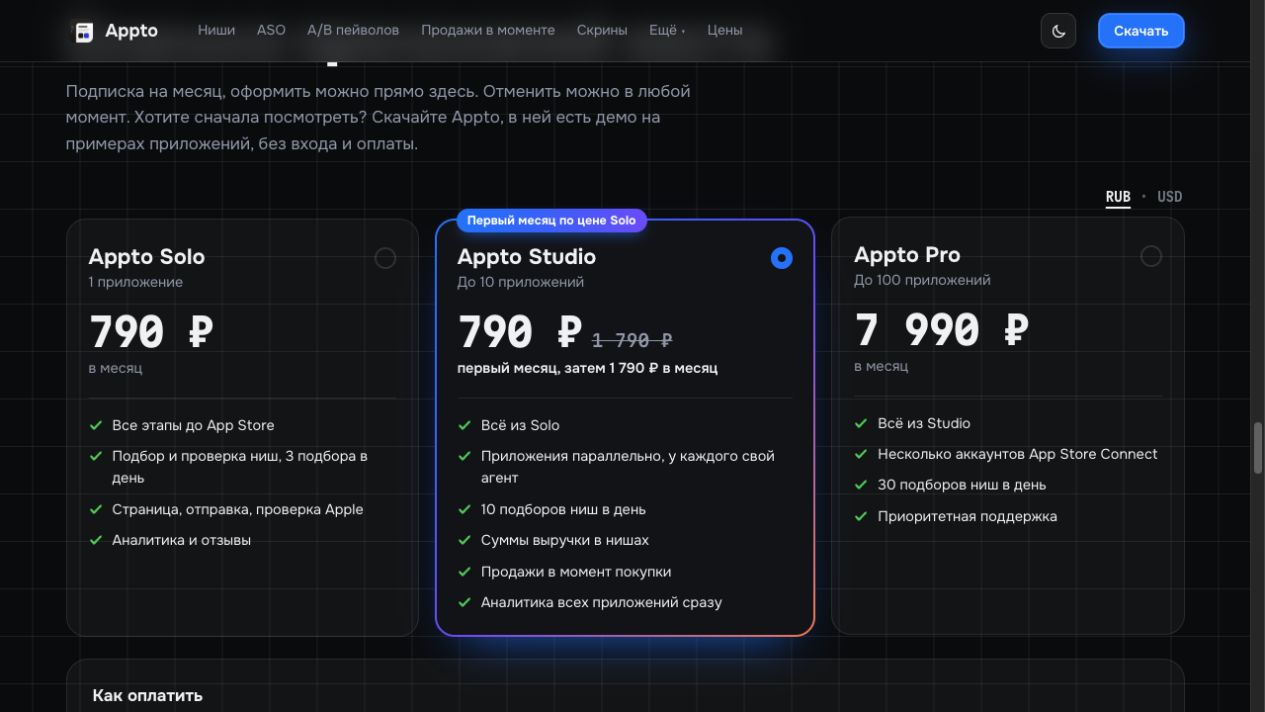
The most interesting citation opportunity is original research
The blog includes an article about the results of selecting niches for iPhone apps. It is signed by the founder and includes a publication date, data date, sample description, tables and methodological limitations. Its value for readers is the ability to understand how a conclusion was reached, rather than just see a final figure.
We did not verify the underlying dossiers or calculations. The author labels revenue figures as estimates, not Apple data. To strengthen the article further, an anonymized calculation example and a small reproducible sample would help: input observations, date, formula, result and limits of applicability. This is our editorial recommendation, not a technical error we found.
The page already identifies an author with a profile link, and BlogPosting contains dates and the same author. There is therefore no need to add a supposedly “missing author.” It would be better to develop the study’s verifiability and a log of substantial updates.
What is actually worth improving
First, add verifiable support to comparisons. The Appto versus Claude Code comparison we read has a task table and a date, but its HTML contained no outgoing HTTP links to the compared product’s documentation. Direct links beside changeable facts will help people verify conclusions and update the content when features or terms change. This finding concerns one reviewed article, not the entire section.
Second, show demonstration boundaries beside each numerical example. The website already labels its gallery as a demo; independent reviews should retain that label for these screens too. Demo revenue and demonstration rankings must not turn into a real customer case study.
Third, connect short feature pages to one complete practical case: the starting task, the person’s role, the result, supporting screens and limitations. This provides a more convincing foundation for recommendations than new pages containing only promises.
Which questions to test and how to measure results
Neutral questions would suit future checks: “Which Mac applications help build a native iOS app using your own AI agent?”, “What can I use to prepare App Store metadata and screenshots?” and “How does an environment for releasing an iOS app differ from a standalone coding agent?” These are suggested test questions, not actual customer queries or query-volume data.
Save the check with its date, chosen service, web search mode, exact answer and source URLs. A name mention, a domain link and a user visit are different events. This review did not include ChatGPT, Gemini or Perplexity sessions, so we do not claim that they already recommend Appto or that the website is absent from their results.
Google states that basic SEO rules apply to AI Overviews and AI Mode: accessibility, indexability, useful text and accurate information. Special “AI markup” is not required. For ChatGPT Search, control of search crawling is connected to OAI-SearchBot; permitting GPTBot training does not replace search access.
Conclusion: develop evidence rather than increase page count
Our Appto sample revealed no basic indexing block: the website delivers readable HTML, canonicals, language alternatives and sitemaps. It already has useful formats for future citations — feature pages, a comparison table, authored content and public terms. The next practical step is to support important claims with primary sources and reproducible examples.
This AURA GEO review provides a public product description and links to the pages examined. After publication, it can be submitted to search engines as new AURA content. This is not submission of someone else’s domain on the owner’s behalf, nor a guarantee of a place in AI answers. Appto’s owner separately has access to their own crawling, indexing and referral data — those will show the actual effect of changes.
Sources
- https://appto.store/ru
- https://appto.store/ru/features/aso
- https://appto.store/ru/features/niches
- https://appto.store/ru/blog
- https://appto.store/ru/blog/134-app-niches-research
- https://appto.store/ru/compare/claude-code
- https://appto.store/ru/press
- https://appto.store/robots.txt
- https://appto.store/sitemap.xml
- https://developers.google.com/search/docs/appearance/ai-features
- https://developers.openai.com/api/docs/bots
- https://aurageo.io/assets/articles/appto-geo-review/audit.json