What YouAstra is and what we checked
ASTRA at youastra.ru is a service offering astrology content, free calculators and an AI conversation partner in Telegram and the browser. The homepage advertises Western and Vedic birth charts, chart-based answers and daily messages. The website itself defines the product as informational entertainment: we assess its structure and content accessibility, not the validity of astrological interpretations.
On 19 October 2026, we examined the public website, robots.txt, sitemap and a sample of pages. The review covers initial HTML and actual screens, but not signing in to the account area. We did not enter birth data into the calculator or test calculations and subscriptions. We have no access to ASTRA’s internal analytics and do not claim that ChatGPT already recommends the service.
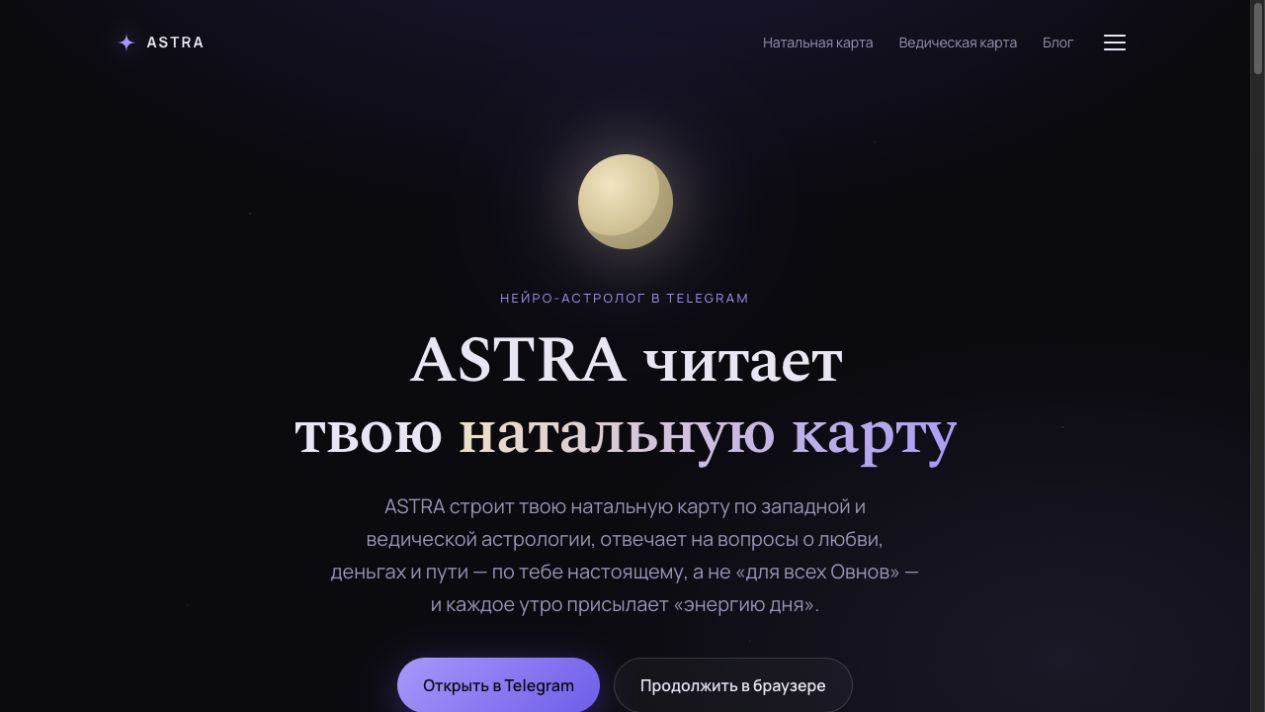
A strength: content is accessible before launching the app
The homepage is more than a splash screen with an “open bot” button. The retrieved HTML contains a feature description, a getting-started workflow, answers to questions, and links to calculators and the journal. The birth chart page explains which data a calculation requires and what the user will receive. A crawler has something to read even without completing the form.
This is an important distinction for a product whose main activity happens in Telegram: private conversations do not replace a public service description. ASTRA already has a public information layer, with the move to personalized interaction kept separate. That connection is worth improving: a clear answer on the website, then a voluntary move to the application, rather than an attempt to make private conversations accessible to search engines.
423 sitemap URLs form a content map, not an indexed-page count
The sitemap contained 423 unique URLs. This indicates the scale of the public library, not the number of indexed or cited articles. In a sample of 10 HTML pages, every response was HTTP 200, each page had one H1 and a self-referencing canonical, and no noindex restriction was found in meta tags or HTTP headers. We did not crawl all 423 addresses this time. All 27 JSON-LD blocks in the sample parsed successfully as JSON; this is a syntax check, not Google rich result certification.
Robots.txt allows crawling through the general User-agent: * rule and specifies the sitemap address. The absence of separate lines naming every AI crawler is not itself an error: without special restrictions, the general permission applies. However, robots.txt is only one access layer. A real search crawler’s request can differ from ours in its IP, network and security treatment. We do not present our own HTML retrieval as a verified visit from OAI-SearchBot, Googlebot or PerplexityBot.
The journal already organizes topics around the product
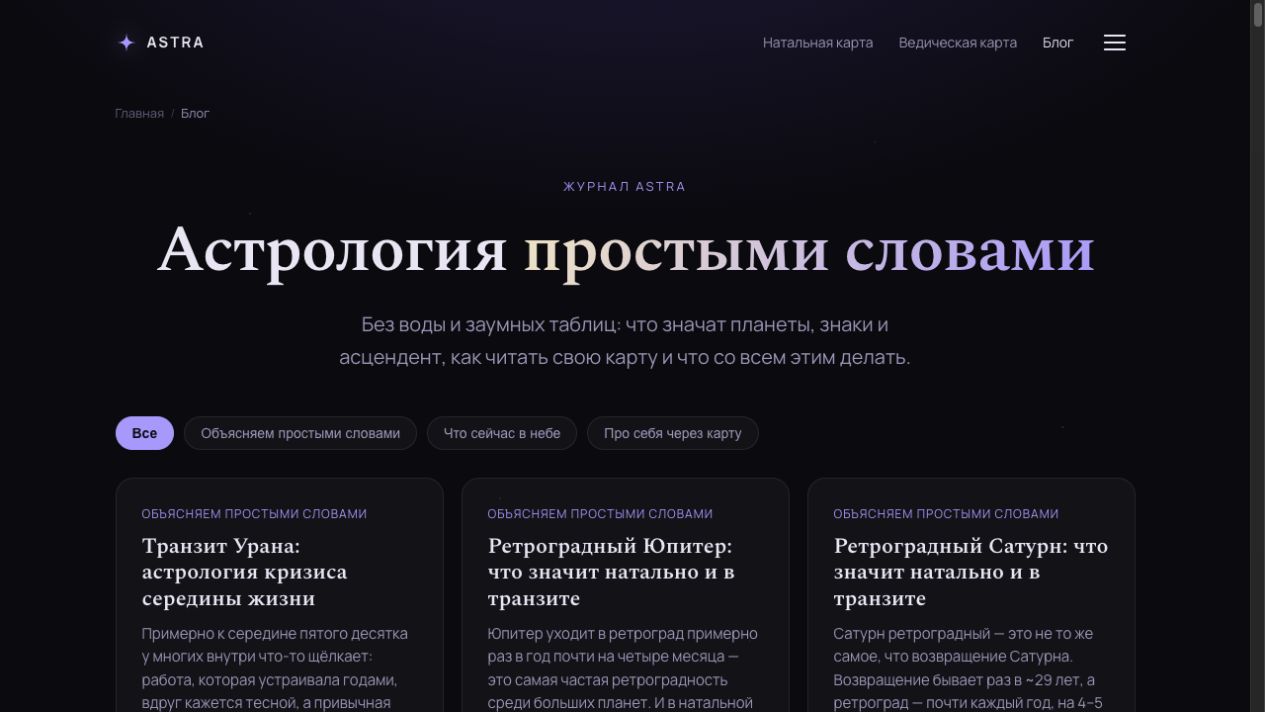
The blog connects to the main sections: birth charts, planets, compatibility and explanations of astrological terms. This is more useful than a set of unrelated promotional notes. A person can first understand a concept and then move to a tool, while a search engine can follow the connections between pages.
Articles about using AI with birth charts are particularly relevant. They answer a question that arises before choosing a particular service: what can the model do, and which input data does it need? As the journal develops, we would retain this principle: one clear task per article, a substantive answer at the beginning, examples and a connection to the appropriate tool. Adding pages for volume is less useful here than improving existing ones carefully.
How to strengthen articles: visible editorial responsibility and verifiable grounds
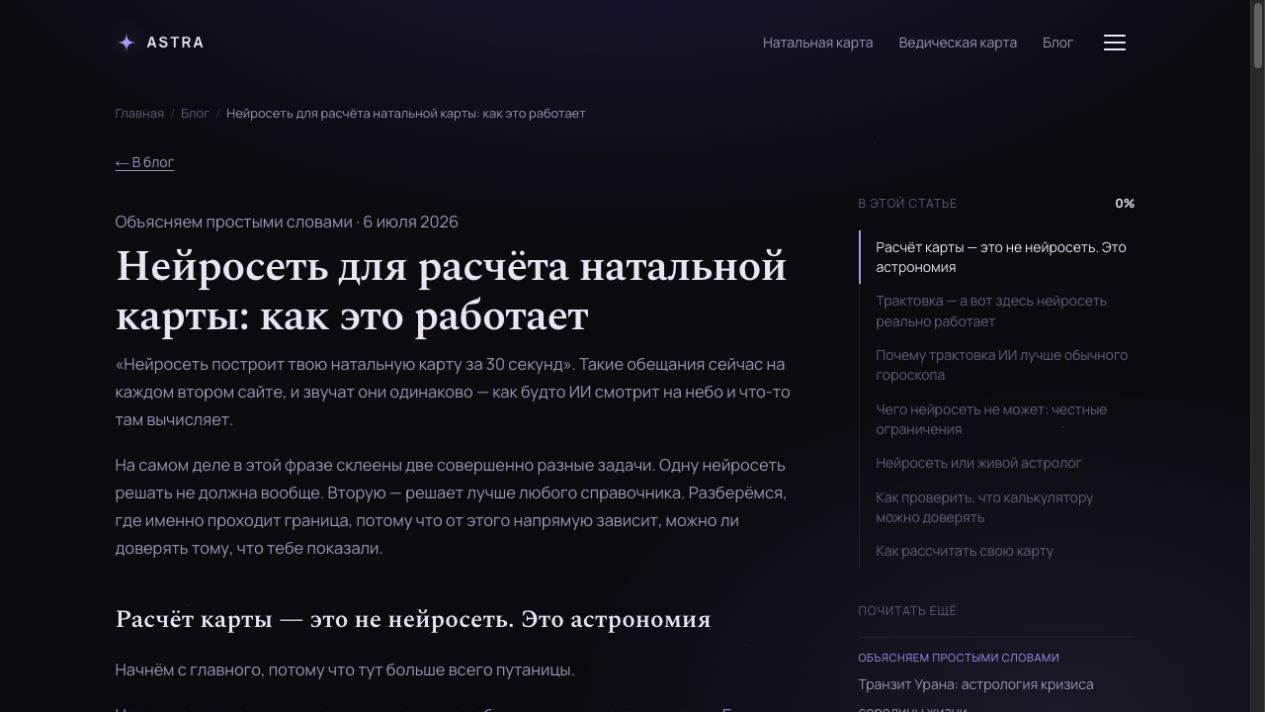
The reviewed articles have headings and dates. The article “AI for a Birth Chart,” dated 6 July 2026, explicitly identifies AI limitations. Explaining product boundaries helps readers understand the answer in front of them. The publication date in structured data matches the visible date; the 17 July modification date matches this article’s lastmod, so there is no inconsistency here.
The next step is a visible editorial byline: who prepared the text, who checked the technical aspects and when substantive details were updated. In all three reviewed articles, BlogPosting identifies the author as the ASTRA organization; this does not mean authorship is absent from the markup. However, a byline on the page and a link explaining the editorial approach would give readers more context. Where text makes verifiable claims about calculations or AI limitations, direct links to the relevant primary sources would help.
A specific mismatch: the policy date and lastmod
The privacy policy page identifies its version as 11 October 2026, while the sitemap reports lastmod of 7 September 2026 for that URL. This is a reason to review the sitemap update mechanism. The discrepancy does not prove a violation of indexing rules and does not itself explain a lack of citations.
If the policy text really changed substantially in October, the sitemap should reflect that change date. If the document date refers to another procedure, clarify this in the editorial process. Do not update lastmod automatically every day for every page: the value should correspond to a real, substantive change. This discipline is particularly important for a project with hundreds of articles, where a shared recent date can easily lose all meaning.
What is missing for comparing the service before moving to Telegram
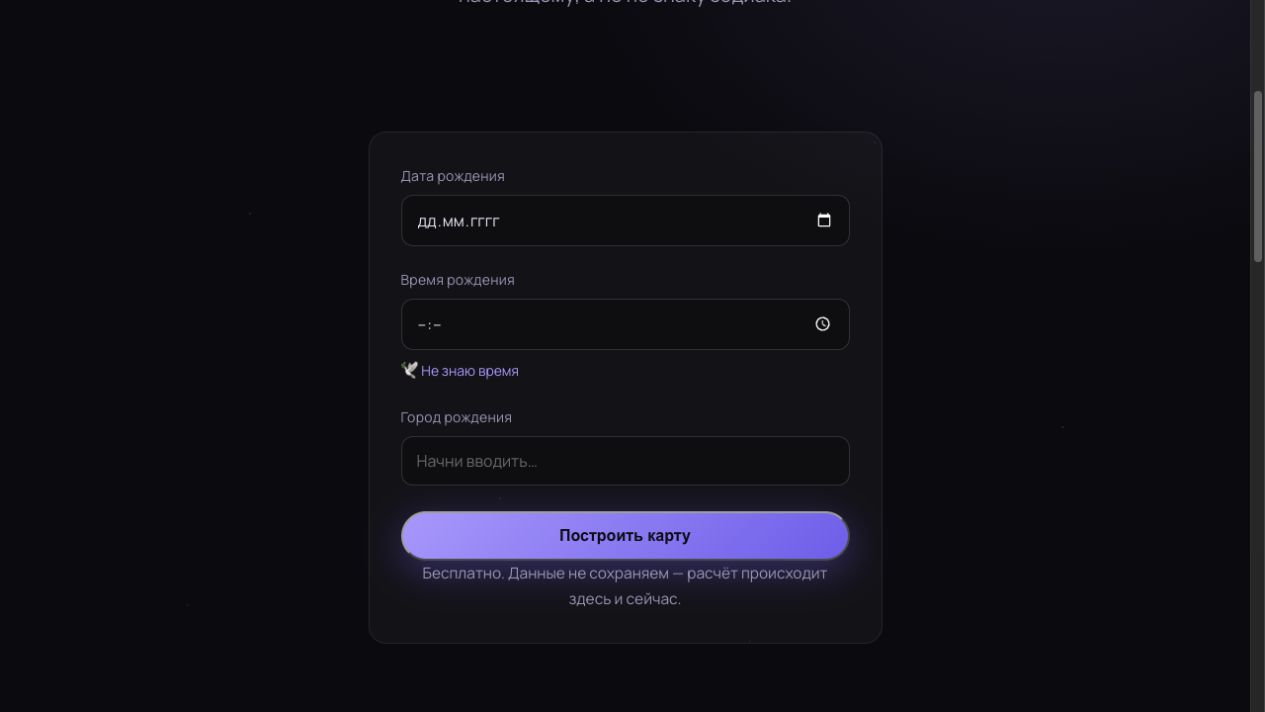
The homepage mentions a free calculation and a trial period, while directing users to the bot for current prices. This is a valid user journey, but it makes it harder for a public page to answer comparison questions: how much access costs, what is included and how subscription options differ. We did not find a separate pricing page in the navigation we reviewed; this is not a claim that one exists nowhere.
A practical improvement would be a public explanation of current terms, with an update date: what is free, which features need a subscription, where to cancel and how Telegram differs from the browser version. These details do not need promotional promises or invented ratings. The easier it is to obtain a verifiable answer from the website, the more substantive the content becomes for people and potential AI search.
Which questions to test and how to measure results
For monitoring, we would suggest a few neutral hypotheses: “Where can I calculate a birth chart online and get an explanation?”, “Which Telegram services explain birth charts using AI?” and “How can I give an existing birth chart to an AI model so it does not invent calculations?” These are examples of research questions, not query-volume data or proven demand.
Test each question separately in the available web search of the chosen AI service, saving the exact answer, date, mode and source links. An ASTRA mention, a link to youastra.ru and a recommendation to use the product are different results. Count visits using the website’s own analytics; an external review cannot reliably estimate their number. Crawl permission, URL submission, search indexing and citation must also be recorded separately.
An improvement plan without rebuilding the entire website
First, we would synchronize lastmod with real updates and make the product’s public terms easy to compare. Next, add editorial bylines, sources for verifiable claims and short, self-contained answers to the most useful articles. Existing tools and the journal remain the foundation. Descriptions and official profiles should consistently use “ASTRA (youastra.ru)” to connect the product name, domain and Telegram bot unambiguously.
After publishing changes, check specific URLs for accessibility, canonical settings and accidental noindex, update the sitemap and notify connected search engines. Then repeat a small set of neutral questions and inspect the actual answer sources. YouAstra’s strengths are already clear: accessible HTML, useful landing pages and a topical library. The next phase is making product and editorial information more precise and easier to use, while preserving evidence of each stage.
Sources
- https://youastra.ru/
- https://youastra.ru/natalnaya-karta
- https://youastra.ru/blog
- https://youastra.ru/blog/neyroset-dlya-natalnoy-karty
- https://youastra.ru/blog/promt-dlya-ii-natalnaya-karta
- https://youastra.ru/blog/tranzit-urana-krizis-serediny-zhizni
- https://youastra.ru/robots.txt
- https://youastra.ru/sitemap.xml
- https://youastra.ru/privacy
- https://developers.google.com/search/docs/appearance/ai-features
- https://developers.google.com/search/docs/crawling-indexing/sitemaps/build-sitemap
- https://developers.openai.com/api/docs/bots
- https://docs.perplexity.ai/docs/resources/perplexity-crawlers
- https://aurageo.io/assets/articles/youastra-geo-review/audit.json