The AURA GEO workspace
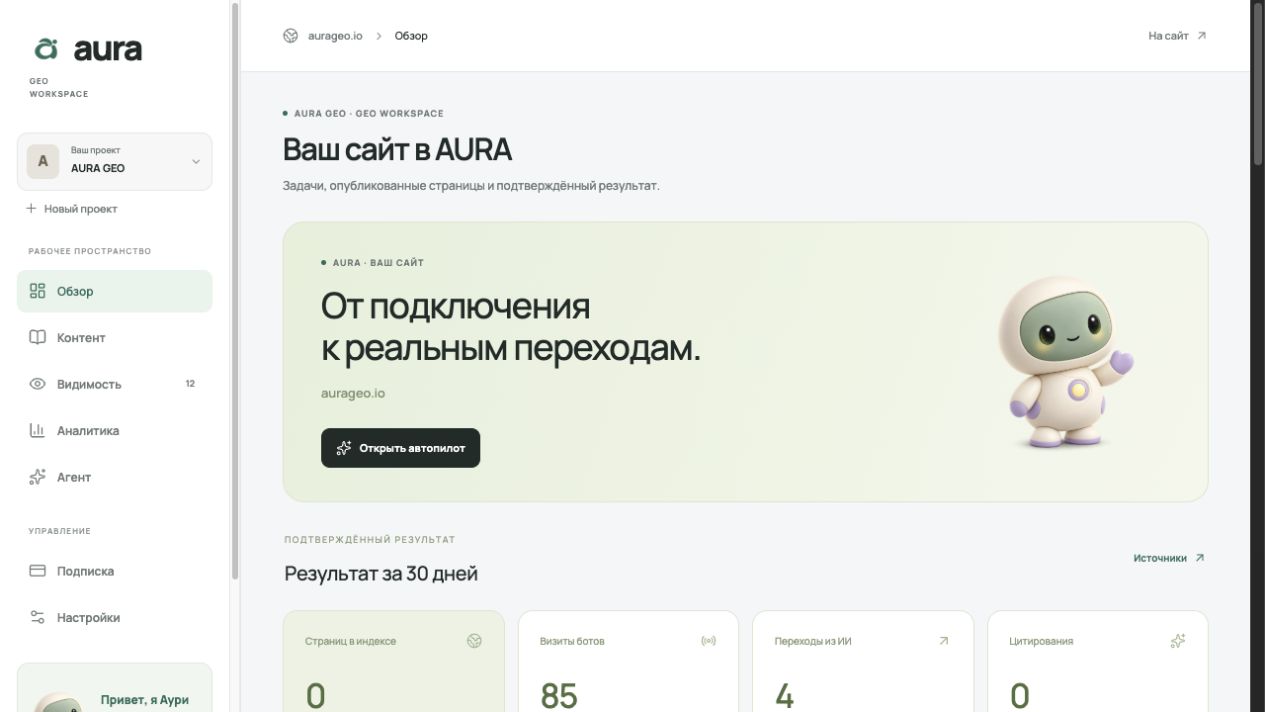
The AURA GEO workspace. One project brings together tasks, content, visibility checks and agent connection.
Where the task begins
I wanted a simple workflow: add a website address, get a clear plan and see what is already done. If you have your own AI agent, delegate the technical work to it.
The hardest part turned out to be defining the result. A page may open in a browser but return an error to a crawler. It may be crawlable but not yet appear in search. And being in search does not itself mean AI will select it for an answer.
In AURA, we therefore separated the stages: page preparation, publication, submission for discovery, observed crawling, indexing confirmation, citation and referrals. Each stage has its own basis for a status.
First, check the website itself
The first step is a technical audit. What does a crawler receive when opening a page? Is the main text in the HTML? Is the page blocked from indexing? Are the primary page address and sitemap specified correctly?
For a self-check, I would start with five things:
1. The page returns a successful server response and is accessible without signing in. 2. The retrieved HTML contains substantive text about the product or service. 3. robots.txt and security settings allow the relevant search crawlers. 4. An important page has no accidental indexing restriction, and its canonical points to an appropriate address. 5. The sitemap contains current public pages that are also linked from within the website.
This is a useful foundation for both conventional search and AI search. For example, Google states that ordinary SEO principles apply to AI Overviews and AI Mode, and special “AI markup” is not required. To appear as a source, a page must be indexed and eligible to show a snippet. Google documentation.
In AURA, audit results become tasks you can revisit after making fixes.
Each AI service has its own route
In the workspace, you can select ChatGPT, Gemini, Claude, Perplexity and other platforms. Routes share a common foundation — website accessibility and quality — and have separate steps for the chosen system.
For example, the ChatGPT route includes search crawler access checks, page checks in Bing and saving an actual answer to a potential customer’s question. Alongside it, you can see which tasks are complete and which answers have been checked.
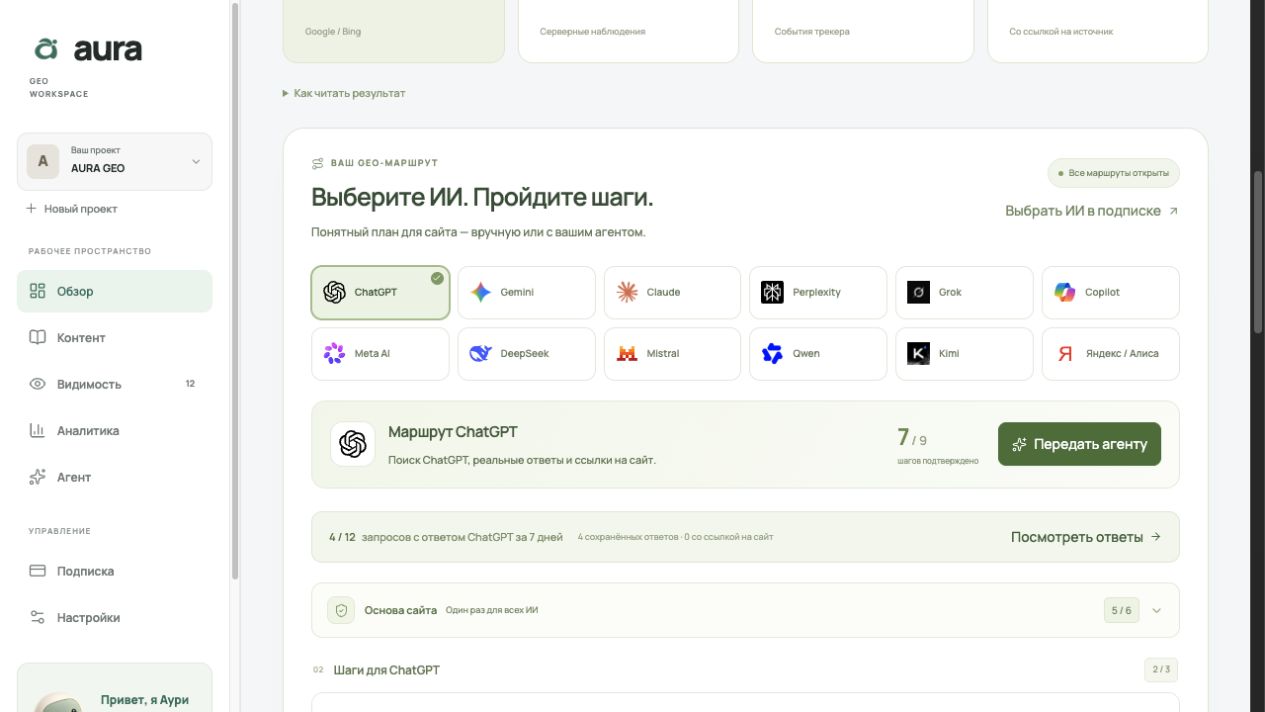
The ChatGPT route in our project. The completed-step count shows work progress; answers linking to the website are tracked separately.
Questions to test should come from the decisions a buyer makes. For our product, examples are: “How can I check whether AI links to a website?” or “Which tools help prepare a website for AI search?”
These questions test a specific situation. A saved answer needs the date, selected system, text and source links. You can then compare the results of a repeat check.
How the agent connects
AURA has MCP — an interface through which an external AI agent retrieves project data and returns work results.
This lets you give it a specific task: read the audit, investigate open tasks, prepare fixes or a page draft, and save the result back. The owner chooses the projects and permitted actions.
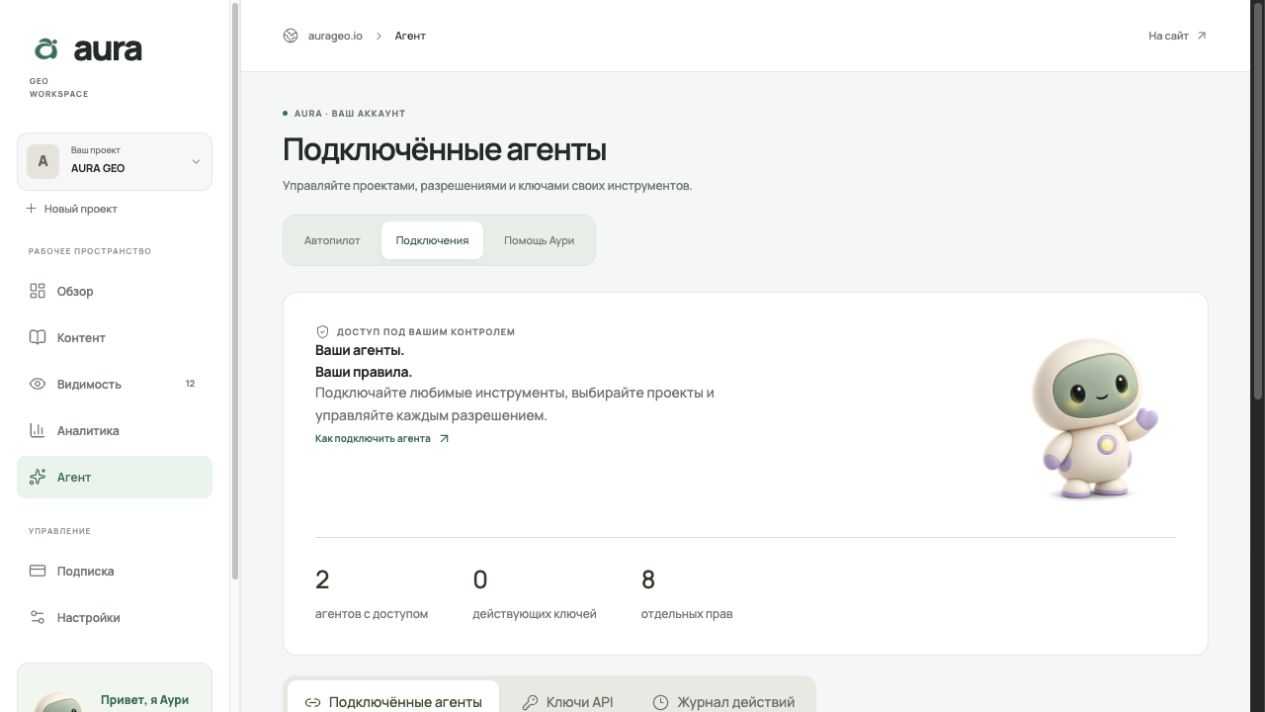
The agent management section. Permissions to read, prepare content and publish are set separately.
To change the website itself, the agent needs access to its files or publishing system. Connecting to AURA gives it context and platform tools; the owner provides hosting access separately.
On our own aurageo.io website, we use the public /answers/ section for articles about GEO, checking AI recommendations and measuring referrals. Readers can reach these pages through ordinary links. Their content can be checked, updated and compared against audience questions.
What counts as a result
For a business owner, the path to a visitor matters. In analytics, we therefore distinguish crawler requests, saved citations and observed referrals from AI.
The referral source is determined from an available referrer or link tag. If an app does not pass the source, the visit cannot be attributed to a particular AI service. Technical tests and our own checks must also be considered when assessing statistics: a tracker event does not yet mean a new customer.
We also record page submission through IndexNow as a separate stage. The protocol notifies participating search engines of changed URLs; the search engine retains the decision about crawling and including the page in search. IndexNow documentation.
This makes it clear where to continue: fix access, improve content, check search status or analyze real answers with sources.
What we want to simplify
AURA GEO brings audits, tasks, content, agent work and result measurement together around one website. The owner can complete steps manually or delegate part of the work to their agent while retaining control of changes.
The project is available at aurageo.io.